Payload · CAN-SBX 2026–27
Hivemind.
Thirty small computers ride a balloon to 30 km. Each one learns from its own sensors during the flight, then shares what it learned instead of its raw data. We want to find out whether learning together beats learning alone at the edge of space.
Selected for CAN-SBX. SEDS-Canada picked Astra Labs for the 2026–2027 Canadian Stratospheric Balloon Experiment Design Challenge, run with the Canadian Space Agency. We're planning to fly in summer 2027.
Read the letterWhy fly it
Satellites will have to learn on their own.
Satellite swarms already collect far more data than they can send to the ground, so future spacecraft will need to learn on board. Federated learning lets many devices train one shared model while each keeps its raw data to itself. Studies say it works for satellites, but those studies are simulations.
Nobody has measured what cold, thin air and failing hardware do to it on cheap microcontrollers. At 30 km the air is about 1% of sea level and the temperature drops to around −56 °C, so electronics lose almost all their cooling. A balloon is the cheapest place to find out, and we plan to publish the data openly.
How it fits together
One rack, two buses, one brain.
Thirty identical nodes sit on a five-level ring rack inside a foam enclosure. They talk to a Raspberry Pi 5 over two CAN buses. The Pi runs the training rounds and radios a short summary to the ground every minute. Everything runs off one central battery.
Swipe sideways to see the whole diagram. Simplified. The full block diagram is in the proposal (Section 2.4).
One training round, every 2 minutes
- SenseEvery node reads its sensors every 5 seconds and logs them to its own flash.
- LearnEach node trains a small model to predict its own readings 1, 3 and 5 minutes ahead.
- ShareNodes send only the change in their model, about 2.9 KB each, over CAN.
- MergeThe Pi averages the updates into one better model and sends it back to every node.
If the Pi goes quiet for two minutes, the nodes keep learning and logging on their own, so the data survives.
What we compare
Every node runs several copies of the same model side by side on the same data, so the only difference is where the learning happens.
Trained on the ground, never updated in flight.
Each node learns alone.
Nodes learn, then the Pi merges them every round.
The Pi learns from all 30 nodes' raw data.
Our bet: federated beats frozen and local, and lands within 10% of centralized while moving far less data.
Key numbers
The structure
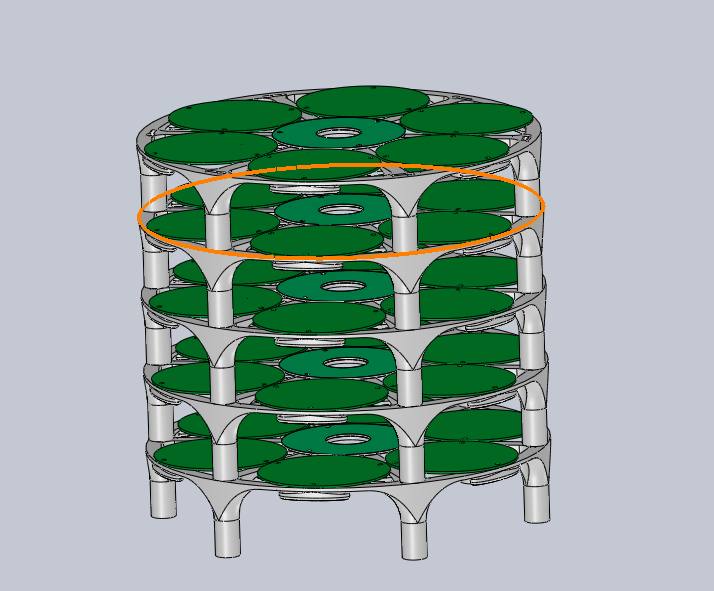
Each level holds six round node boards around a central bay for the computer and the battery. Five levels fit inside the 600 × 300 mm cylinder the challenge allows, at about 3.4 kg of the 5 kg limit.
It works at any orientation, because the payload spins freely under the balloon. Orientation is logged as data.
Next phases
From the bench to 30 km.
- Dec 2026 – Apr 2027Collect data
Bench, cold and vacuum runs, drone flights, public weather-balloon records and a simulator.
- Apr – May 2027Train on the ground
Train the starting model and check it gives the same answers on the nodes and the Pi.
- Summer 2027Learn in flight
All four learning modes start from the same model and learn live for about three hours.
- After recoveryAnalyse and publish
Score every mode and release the dataset, firmware and node design openly.
Still to prove
We've only tested the training code on one bench board with simulated data. Here's what hasn't been tested yet.
Where it came from
Pioneer, our first rocket, was meant to carry an early sensor swarm, the Picosat concept test. It didn't pass pre-launch inspection at Launch Canada 2026: there were faults in both the payload and the rocket's assembly. That's why Hivemind puts every node through bench, cold and vacuum tests before it gets anywhere near a launch. About the concept test →
Read the documents
See it for yourself.
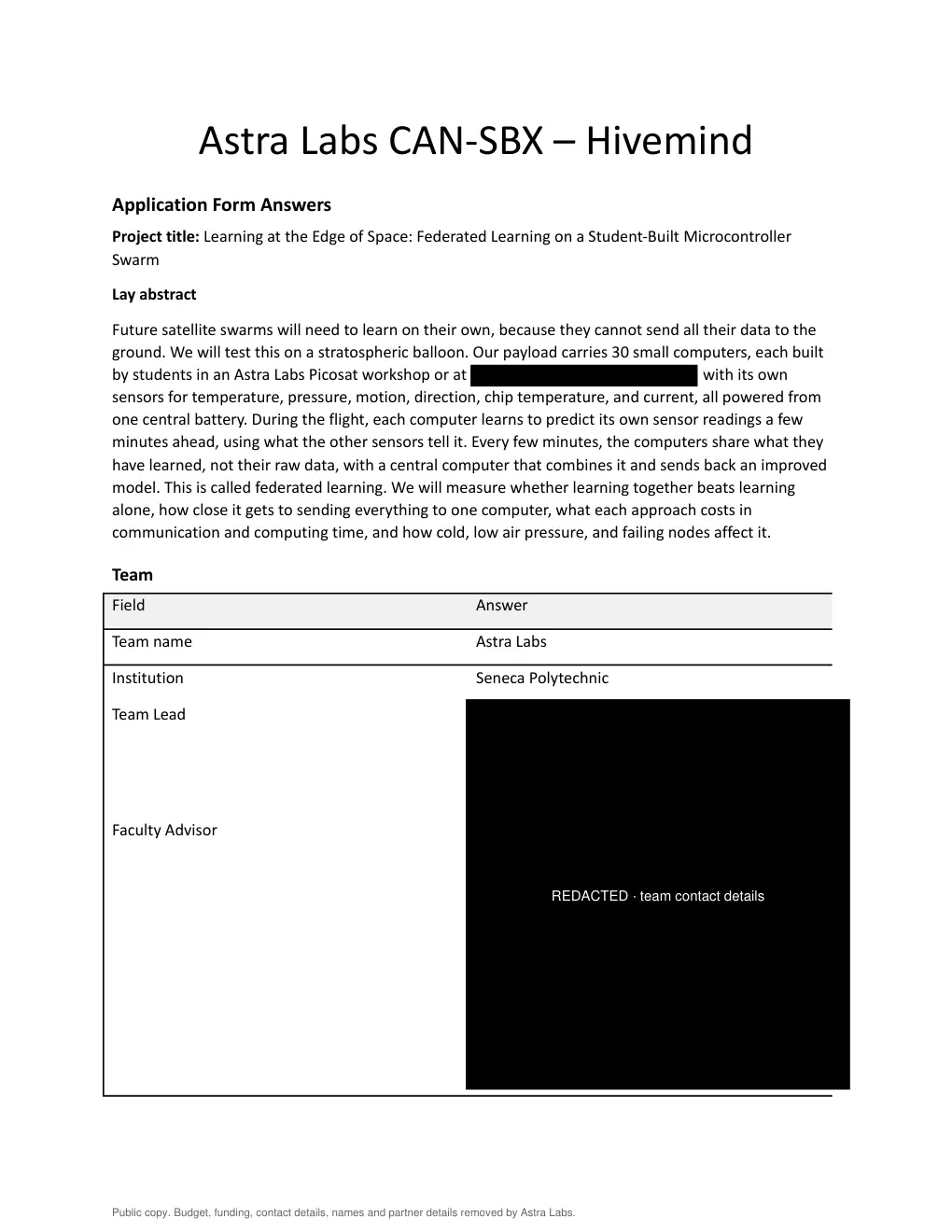
The proposal we sent SEDS-Canada and our selection letter, right here on the page. No download needed.
Get involved
Help us get it off the ground.
Students will build the flight nodes in a hands-on workshop. Companies can help pay for parts, testing and getting the team to the launch.